
Aug 26, 2026
In honor of the Charles L. R. Holt Memorial Art Installation, we invited Pat Holt to share reflections on her husband’s life, career, and lasting impact on the water industry. Through her memories, Pat offers a personal look at Charles’ journey, the relationships he built, and the legacy he leaves behind.
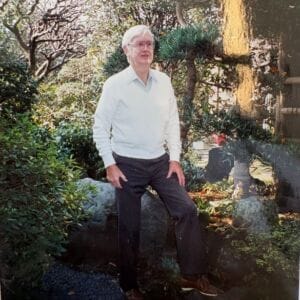
1. Can you tell us a little about your husband and the path that led him into the water industry?
Lee was born in Evanston, IL and attended the University of Wisconsin, planning a career in medicine. While in pre-med he took a class in geology, which changed his life plan. It led him to a BS in Geology and a MA/Petroleum Geology. After a short stint working at an oil company, he realized that the petroleum field was saturated. In 1949 he was hired as a ground water geologist for the Texas Board of Water Engineers and found his passion. His geological survey of water resources in Medina County Texas was published in a 220 page report. In 1950 he began working for the Texas District of the USGS, and in 1953 transferred to the Wisconsin District.
2. What did he enjoy most about working in the water sector, and what did that work mean to him?
Promotion to District Geologist of the ground water branch in 1957 and to District Chief of the Water Resources Division in 1966 were indicative of his dedication to the importance of solving water problems, ensuring water quality and protecting water resources. Staff training centered on problem solving.
3. Are there any moments from his career in water that stand out as especially meaningful or memorable?
In 1970 Lee participated in a USAID mission to assist the Government of India and the States of Gujarat, Madhya Pradesh, Maharashtra and Mysore in planning ground water development for irrigation. The plan and report were approved by Indian agencies and USAID and put into action in 1972.
In 1975 he was promoted to Regional Program Planning Officer for the Southeastern Region of the U.S. and Puerto Rico in Atlanta Georgia. He retired in 1980.
In the same year with USAID support, prepared in cooperation with the Natural Resources Authority of Jordan, a proposed program for systematically assessing the ground water resources of northern Jordan was initiated. The program was approved and funded by Jordan and USAID. Lee led the program from its inception in May 1981.
4. How did his work in the water industry shape the way he saw the world?
While handling USGS responsibilities, writing publications and reports, heading cooperator organizations, Lee found relaxation in nature. As an Eagle Scout leader, he led boys and young men on camping trips, cave exploring, nature walks identifying rocks, rock formations, kayaking and canoeing.
5. When did he first discover his passion for art? Was he creating while he was still working in water, or did that come later?
Using driftwood from Lake Superior he created wax and sand/driftwood planters, lamps and candles for sale and as gifts. He became a prize winning photographer, with nature as his subject and made and bottled his own wine, sharing it with friends and family.
6. Did his experiences in the water industry influence the themes, subjects, or techniques in his artwork?
When he retired and moved to Port Aransas Texas, he decided to take a class in clay, saying he’d been around it all his life and now wanted to explore a new way to see it. One semester at the local university created such enthusiasm and output that he built a studio in the back yard, ordered a large kiln and began experimenting with clays and glazes until he found his exactly right combinations.
7. How did his artistic journey evolve over time?
His reputation as an artist was launched. Before long he was winning prizes and had gallery representation. The competitions grew from local to state to national opportunities and prizes were often the result.
8. What inspired him most when he was creating?
Water was a theme in almost all of Lee’s work. His raindrop head water spirits with geologic bodies were stunning examples of his understanding of water and all it exemplifies. Whether wall sculptures, stand alone pieces, or his fresh and salt water fish, all reflected his appreciation of the wonders of nature.
9. Your husband received several awards for his artwork. Which awards, and what did that recognition mean to him?
Of his many awards, his selection for the nationwide Monarch Tile Competition stands out because the juror pointed him out in her speech to the participants and attendees that only one person selected did not have a MFA and it was Lee Holt. A hydrologist had taken up art in his retirement, and this was the result – recognition and his work traveling to Monarch’s headquarters.
10. Is there a particular piece of his artwork that holds special meaning for you or your family?
One of the pieces I can’t bear to part with is his Man Arising from a Lotus Blossom, aka Myth of the Earth Spirit. I saw that his imagination had made a leap into another sphere. The end result was truly brilliant. He won the Wisconsin Triennial with that sculpture the first time he entered.
11. What do you think people would be most surprised to learn about him?
Most collectors are surprised and delighted by his Spirit Houses and his sense of humor with the creation of Hobbit House and Fish Life, both in museum collections. Children climb up steps to peer through holes carved into the structures to see a Hobbit House interior or fish and underwater life suspended by filament to create a vibrant example of a snorkeling experience.
12. What does it mean to you to have his artwork displayed at The Water Tower?
To have two of his wall geologic wall reliefs selected by The Water Tower is a tribute to the years Lee gave to the study and protection of water resources. He wanted the viewer to see how insignificant we are compared to the thousands of years of formations beneath us.
13. What do you hope visitors take away when they see his work here?
I hope the viewer can see that we are a tiny part of the universe and that these reliefs teach us to look at our universe in new and different ways.
14. If you had to describe your husband in just a few words, as both a water professional and an artist, what would they be?
Lee was passionate about his work as a hydrologist with the Water Resources Division of the U S Geological Survey and continued that passion into his retirement. He was an expert in the field of groundwater hydrology and dedicated his energy to help understand and protect the water resources of our nation as well as those in other parts of the world.
15. What legacy do you hope his work and story leave behind?
By creating joint exhibitions between Wisconsin and Japanese artists their work was exhibited and enjoyed in Wisconsin museums and art centers, and Wisconsin Visual Artists Association members were exhibited in Japan, the first time ever that a Japanese artist exhibited with another, let alone with an artist from another country and in a variety of mediums. We made art history by exhibiting together and housing artists with artists.
The Water Tower extends our sincere thanks to the Holt family for generously donating Charles L. R. Holt’s artwork to our campus. His pieces are now on permanent display in the lobby of The Water Tower, where they will continue to honor his legacy and connection to the water industry.
The Water Tower consists of two nonprofit organizations: The Water Tower at Gwinnett, a 501(c)4 – responsible for the development and operations of the campus, and The Water Tower Institute, a 501c3 – responsible for solutions, instruction, and engagement programming. Together, these entities are cultivating an ecosystem of water innovation fueled by imagination, informed by research, and powered by pioneers. The Water Tower brings together public and private sectors of the water industry, side by side with academia and nonprofits, to tackle the industry’s greatest challenges.